
How to Choose Readings for a Wedding Ceremony
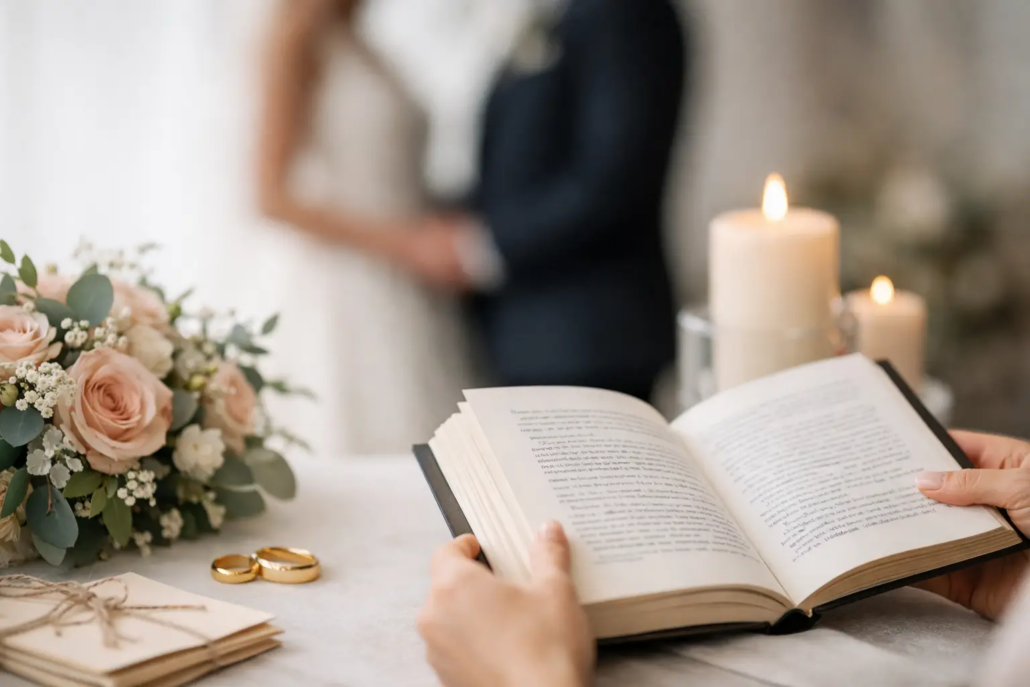
The right reading can make a room go quiet in the best possible way. It can bring laughter, honor someone you love, acknowledge your faith or culture, or put words to feelings that are hard to say aloud. When you choose readings for wedding ceremony moments, the goal is not to find the most famous passage. It is to find words that sound like they belong in your story.
For couples planning a Seattle or Western Washington wedding, that may mean a poem read beside the water, a bilingual passage shared with family, a short excerpt at an intimate elopement, or no formal reading at all. Every one of those choices can be meaningful. The best ceremony is not the one that checks every traditional box. It is the one that feels honest when you look at each other.
Start with the feeling you want guests to carry
Before searching poems, novels, songs, or religious texts, decide what you want the reading to do. Do you want guests to laugh because it sounds like the two of you? Do you want a quiet, emotional moment before your vows? Are you hoping to include grandparents, children, or a cultural tradition that matters to your family?
A reading does not need to explain your entire relationship. In fact, shorter is often stronger. A well-chosen passage of one to three minutes gives everyone a moment to breathe and listen without slowing the ceremony’s pace. If you are having a very short ceremony, one brief reading may be plenty. If you are planning a longer, more personalized celebration, two readings can create a lovely rhythm.
Think about the overall tone, too. A funny reading can be perfect for a relaxed backyard wedding, but it may feel out of place if the rest of the ceremony is deeply formal and reflective. There is no wrong combination, but the pieces should feel like they belong together.
Choose readings for a wedding ceremony that sound like you
The most meaningful readings usually reflect a couple’s real values, not just a Pinterest-perfect idea of romance. Start by talking privately about what marriage means to each of you. You may find yourselves drawn to commitment, friendship, adventure, resilience, family, faith, humor, or choosing one another again and again through ordinary life.
If you love literature, an excerpt from a favorite novel may be the natural choice. If music has been part of your relationship, lyrics can work beautifully when they are read as poetry, provided the language fits the setting. If faith is central to your life, a scripture passage, blessing, or prayer may feel essential. For secular couples, poetry and prose often offer the same sense of depth without religious language.
You also have permission to skip readings that do not fit. A passage can be beloved by a parent, common at weddings, or objectively beautiful and still not feel right for you. Your ceremony is a place to welcome the people who shaped you, but it does not have to become a performance of anyone else’s expectations.
Consider who will read it
A reading can be a meaningful way to involve someone who is important to you but is not in the wedding party. A sibling, close friend, adult child, grandparent, mentor, or chosen family member may be honored to take part.
Choose someone who will be comfortable speaking in front of a group. They do not need to be a professional speaker, but they should be able to read slowly, clearly, and warmly. The person with the deepest emotional connection is not always the best reader if public speaking makes them freeze. You can always involve that person in another way, such as a toast, a family blessing, or signing your marriage license as a witness.
Once you choose a reader, send them the final text well before the wedding. Ask them to practice out loud, especially if the passage includes unfamiliar names, another language, or poetic phrasing. Remind them that a calm pace is more powerful than rushing. A short pause before and after the reading gives the words room to land.
A note for bilingual and multicultural ceremonies
For bilingual ceremonies, readings can create a beautiful bridge between families and generations. You might select one passage in English and another in Spanish, or share the same reading in both languages. The best choice depends on your guests, ceremony length, and whether the translation carries the same tone and meaning.
Avoid assuming that a word-for-word translation will always sound natural when spoken aloud. Some passages are more elegant in one language than another. A personalized officiant can help you decide whether to read both versions in full, offer a shorter translation, or select complementary readings that honor each language without repeating the entire moment.
Balance family wishes with your own voice
Many couples are navigating loving but very different family expectations. One family may hope for a Bible verse, while the couple prefers a secular ceremony. A grandparent may want a traditional reading, while you are planning a modern, non-denominational celebration. These conversations can feel larger than a single paragraph in a ceremony.
There are gentle ways to make room for what matters without giving up your voice. You might include a short blessing from a family member while keeping your vows and main ceremony language secular. You could choose a reading about love and partnership that is meaningful across beliefs. Or you may decide that the most respectful choice is a clear boundary: this ceremony will reflect the two people getting married.
What matters is that neither of you feels pressured into words you cannot stand behind. Your guests will remember the authenticity of the moment far more than whether every tradition was included.
Keep the ceremony moving
A reading should add meaning, not create a traffic jam in the middle of the ceremony. As a general rule, aim for 150 to 300 words per reading. That is enough time for emotion and reflection without asking guests to sit through a mini-lecture on love.
If you have two readings, vary the energy. Pair a thoughtful poem with a lighter prose excerpt, or follow a faith-based passage with a personal reflection from someone close to you. If you have children participating, choose something brief and age-appropriate. A child can read a few lines beautifully, but a long passage can become stressful for them and for you.
Timing matters, too. Readings often work well after the welcome and before vows, when everyone has settled in and the emotional focus is building. In some ceremonies, a reading after the vows can feel especially powerful because it reflects the promises you have just made. There is no fixed rule. It depends on the flow you want.
Give your officiant the final version
Even a wonderful reading can lose its impact if no one knows where it belongs, who is introducing it, or what happens afterward. Share the exact text and reader’s name with your officiant as early as you can. If your reader changes at the last minute, tell your officiant so they can make the transition feel natural rather than awkward.
It also helps to rehearse the practical details: where the reader will stand, whether they need a microphone, and whether they will read from a phone, printed page, or small book. Printed pages are usually easiest outdoors, especially in the Pacific Northwest breeze. Use a large, readable font and avoid a page that requires frantic shuffling mid-reading.
At Forever, Together, personalized ceremony planning includes guidance on readings, placement, and participation, so you do not have to solve those details alone. The goal is to make the ceremony feel relaxed and natural, even when it carries a lot of heart.
When no reading is the right choice
Not every wedding needs a formal reading. If you are eloping, holding a short legal signing, feeling nervous about public attention, or simply want to get to your vows, skipping readings is completely valid. Your officiant can still build warmth and personality into the welcome, relationship story, and closing words.
Some couples choose to incorporate meaningful words in another way. You might print a favorite quote on your program, have it engraved on a keepsake, include it in a private letter exchange, or ask a loved one to share it during the reception toast. Meaning does not disappear just because it is not read at the ceremony.
The right reading is the one that makes you think, “Yes, that is us.” Give yourselves permission to take your time, read it aloud together, and trust your reaction. If it brings a lump to your throat, a grin to your face, or a sense of calm about the commitment ahead, you have probably found your words.