
Do Bilingual Ceremonies Work Smoothly at Weddings?
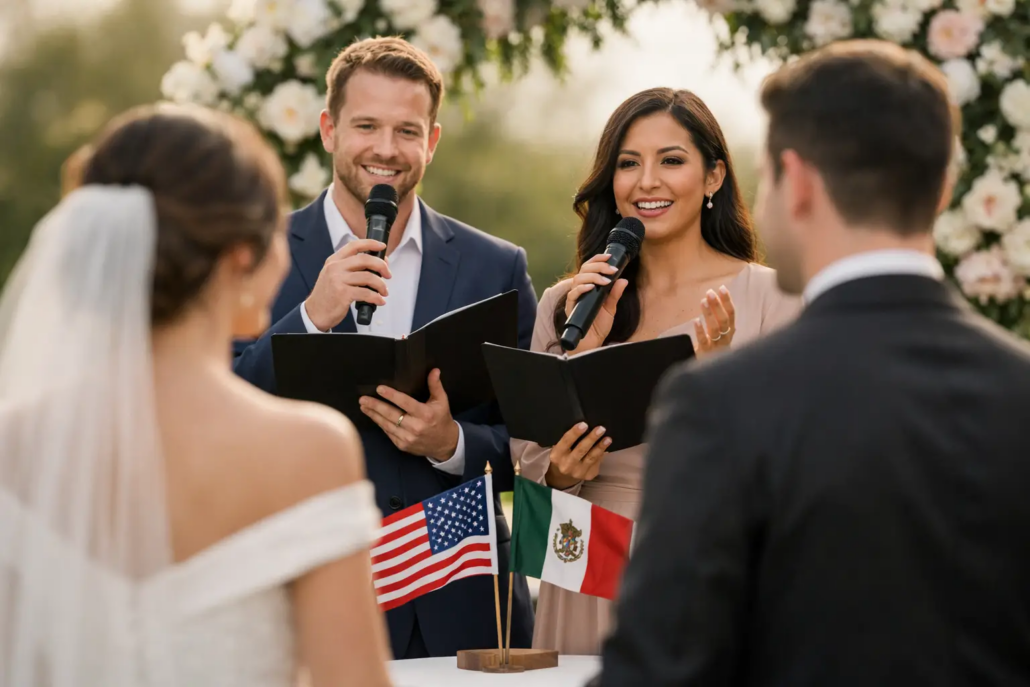
A grandmother hears her language spoken during the vows and immediately reaches for a tissue. A partner’s college friends understand the story of how the couple met. Nobody is left politely smiling through a moment they cannot follow. That is the real answer to the question, do bilingual ceremonies work smoothly: they absolutely can, as long as the ceremony is designed for the people in the room, not simply translated word for word.
A bilingual wedding ceremony is not twice as complicated as a one-language ceremony. It does require a few thoughtful choices about pacing, translation, family participation, and what matters most to each of you. With a clear plan and an officiant who is comfortable guiding both languages, it can be one of the most meaningful parts of your wedding day.
Do Bilingual Ceremonies Work Smoothly? Yes, With a Plan
The concern couples often share is understandable: Will the ceremony feel too long? Will one group of guests feel left out? Will the translations sound stiff or repetitive?
Those problems can happen when bilingual elements are added at the last minute. They are far less likely when the ceremony is written as one complete experience from the beginning. The goal is not to duplicate every sentence perfectly. The goal is for everyone to understand the heart of the ceremony and feel that they belong in it.
A well-planned bilingual ceremony has a natural rhythm. Your guests hear both languages often enough to stay connected, while the ceremony still moves forward with warmth and purpose. It should feel like your wedding, not a language lesson with flowers.
For many Seattle and Western Washington couples, bilingual ceremonies also carry a deeper purpose. They may honor Spanish-speaking parents or grandparents, bring together families from different cultural backgrounds, or reflect the language a couple uses at home. Including both languages says, clearly and beautifully, that both sides of the family matter.
Choose the Right Bilingual Ceremony Format
There is no single correct way to include two languages. The best format depends on your guest list, your comfort speaking each language, and the role language plays in your relationship.
Full translation throughout
In this format, the officiant delivers each major part of the ceremony in English and Spanish, or in the two languages you choose. The welcome, relationship story, vows, ring exchange, pronouncement, and closing all receive translation.
This is a wonderful option when guests are fairly evenly divided between languages or when you want every guest to understand every moment. The trade-off is time. A ceremony written this way may run closer to 25 or 35 minutes than 15 or 20 minutes. That is not a problem when the writing is personal, the delivery is lively, and guests know they are being considered.
Key moments in both languages
Many couples choose a more concise approach. The officiant may welcome everyone in both languages, tell the couple’s story primarily in one language with a brief summary in the other, and offer the vows, ring exchange, and pronouncement bilingually.
This format is often ideal for couples who want an intimate ceremony with a comfortable pace. Everyone receives the emotional highlights, and the ceremony does not feel overly repetitive. It also works especially well when most guests understand some English or Spanish but feel more emotionally connected when they hear significant words in their first language.
Shared-language participation
A bilingual ceremony can also invite loved ones into the experience. A parent might offer a reading in Spanish, a sibling may give a blessing in English, or both families may respond to a question of support in their preferred language.
These moments can be incredibly moving, but they work best when they are planned with care. A reading does not always need a full translation afterward, particularly if the meaning is introduced beforehand. An officiant can frame it simply: “Maria will now share a blessing for the couple in Spanish.” Guests understand what they are witnessing, even if they do not catch every word.
Translation Is About Meaning, Not Matching Every Word
Literal translation is one of the quickest ways for a ceremony to sound awkward. Idioms, humor, religious references, and promises often do not carry the same tone from one language to another.
A good bilingual ceremony translates the intention. If one version says that a partner brings “calm in the chaos,” the other version should convey that feeling in language that sounds natural to native speakers. If your story includes a funny detail, it may need a slightly different phrasing in each language to land well with both groups.
This is especially true with personal vows. You do not have to give matching vows in both languages unless that feels right to you. One partner might speak their vows in English and the other in Spanish, with a brief translation provided by the officiant or included in the printed program. Or each of you may say a short repeated vow in both languages, then share personal promises in the language that feels most honest.
The best choice is the one that lets you be present. Your wedding vows should not feel like a performance test.
Keep the Pace Comfortable for Guests
Bilingual ceremonies need breathing room, but they do not need to drag. A few practical decisions make a noticeable difference.
First, avoid translating small logistical remarks that do not carry emotional weight. Guests do not need every transition repeated. Second, choose a ceremony length that fits your setting. A quiet indoor ceremony may support more spoken content than a windy waterfront ceremony where guests are bundled in coats and toddlers are reaching their limits.
Third, make the important phrases easy to hear. If you are hosting a larger wedding, use a microphone. This is not only for older guests. It helps everyone stay with the ceremony, especially when they are listening in a language that may not be their first.
A simple printed program can help, too. It can list the ceremony order, identify readings, and provide short translations for a poem, prayer, or cultural tradition. It should support the spoken ceremony, not replace it.
Let Family Expectations Inform, Not Control, the Ceremony
Language can bring up strong feelings in families. A parent may hope to hear a traditional blessing. A grandparent may worry they will not understand the vows. Another relative may have opinions about which language should come first.
Those feelings deserve kindness, but the ceremony still belongs to the two of you. You can honor family without creating a ceremony that feels unlike your relationship. Sometimes that means including a Spanish welcome and blessing in an otherwise English-forward ceremony. Sometimes it means making both languages equally present. Sometimes it means choosing a secular ceremony while still using language that reflects a family’s heritage.
The helpful question is not, “What will make everyone perfectly happy?” Weddings rarely offer that magic trick. Ask instead, “What will help our loved ones feel respected while still feeling true to us?” That answer gives you a much stronger foundation.
Work With an Officiant Who Can Lead Both Languages Naturally
A bilingual ceremony is easier when your officiant understands more than vocabulary. They need to know when to slow down, where to place translations, how to pronounce names correctly, and how to make both groups of guests feel directly welcomed.
During the planning process, share which languages your guests speak, whether anyone will need full translation, and which parts of the ceremony matter most to your families. Be open about your own comfort level, too. You do not need to be fluent in both languages to have a bilingual wedding. You simply need a ceremony design that supports you.
At Forever, Together, bilingual ceremonies are created around the couple rather than pulled from a generic script. That leaves room for cultural traditions, personal stories, family readings, and the small details that make guests say, “That was so them.”
Your ceremony can hold more than one language without losing its warmth, humor, or momentum. When the words are chosen with care, each translation becomes more than an explanation. It becomes an invitation for the people who raised you, loved you, and traveled to celebrate you to feel fully present when you say, “I do.”