
Elopement vs Traditional Wedding: Which Fits?
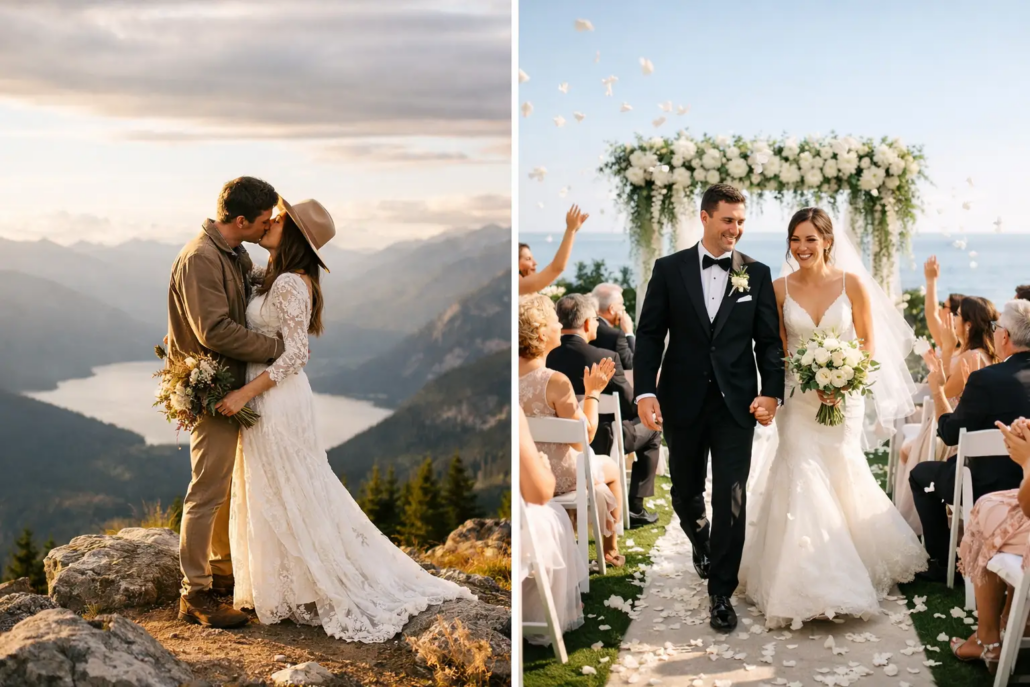
One couple wants a quiet ceremony on a bluff above Puget Sound with two witnesses and a dinner afterward. Another wants grandparents in the front row, a bilingual reading, a packed dance floor, and a full weekend of celebration. Neither is doing it wrong. When couples ask about elopement vs traditional wedding, they are usually not just comparing event styles. They are trying to figure out what will feel most like them.
That question matters more than trends. A wedding can be deeply meaningful with just the two of you, and it can be deeply meaningful with 150 guests. The right choice depends on your budget, your family dynamics, your tolerance for planning, and the kind of memory you want to create when you make things official.
Elopement vs traditional wedding: what is the real difference?
The simplest difference is scale, but that is not the whole story. An elopement is typically smaller, more flexible, and centered on the couple’s private experience. A traditional wedding usually includes a larger guest list, more structured logistics, and a broader focus that includes hosting family and friends.
In practice, the line can blur. Some elopements include a few loved ones, a photographer, and a beautifully personalized ceremony. Some traditional weddings are intentionally simple, without a huge reception or a long list of formalities. This is why labels only help so much. What really matters is how much of the day is about intimacy, and how much is about gathering and celebrating with your wider community.
If you are trying to decide, it helps to stop asking, “What are people doing right now?” and start asking, “What will feel calm, honest, and joyful for us?”
Why couples choose an elopement
Elopements appeal to couples who want less pressure and more presence. If the idea of managing seating charts, vendor timelines, plus-one politics, and family expectations makes your shoulders tighten, a smaller ceremony can feel like a very good exhale.
There is also a financial piece. An elopement usually costs far less than a traditional wedding, which can free up money for a home, a trip, debt payoff, or simply a little breathing room. That does not mean an elopement has to feel bare-bones. Many couples use the smaller scale to invest in what they care about most, whether that is a meaningful location, gorgeous florals, great photography, or a ceremony that feels personal instead of rushed.
Privacy is another reason couples lean this way. Some people are deeply uncomfortable being emotional in front of a crowd. Others want the freedom to cry, laugh, say private vows, or include spiritual or cultural elements without feeling like they are performing. An elopement can create space for that.
It also works well for practical situations. Maybe you are planning on short notice, blending families, coordinating across states, or trying to keep things simple because life is already full. A smaller wedding often gives you more flexibility with timing, location, and format.
Why couples choose a traditional wedding
A traditional wedding gives you something an elopement usually cannot – the experience of gathering your people in one place to witness and celebrate your marriage. For many couples, that matters a lot.
If your relationships are central to how you mark big life moments, a larger wedding can feel right. Parents, siblings, close friends, children, grandparents, and chosen family all get to be part of the memory. That can be especially meaningful in families where weddings are cultural milestones, community events, or one of the few times everyone comes together.
Traditional weddings also create room for shared rituals. Processionals, readings, music, religious or secular traditions, bilingual moments, unity rituals, and speeches can all add emotional depth. When done thoughtfully, these details do not make a wedding feel generic. They make it feel layered and lived in.
And despite what people sometimes assume, a traditional wedding does not have to mean stiff or overly formal. It can still be intimate, personal, and relaxed. A larger guest count and a custom ceremony are not opposites. You can absolutely have both.
The trade-offs most couples do not see at first
Every wedding style solves certain problems and creates others.
Elopements are simpler, but simplicity can come with emotional complexity. You may love the idea of a private ceremony and still feel sadness about who is not there. Family members may be supportive, disappointed, or somewhere in between. If you elope partly to avoid conflict, that can work, but it is worth being honest about whether the conflict will truly disappear or just be postponed.
Traditional weddings create connection, but they ask more from you. More planning, more money, more logistics, more personalities. If you know that hosting a large event will make you so stressed that you cannot enjoy your own ceremony, that matters. A beautiful wedding is not just one that photographs well. It is one where you actually feel present.
This is where values help. If your top priority is intimacy and ease, an elopement may fit best. If your top priority is bringing everyone together, a traditional wedding may be worth the extra effort. If your priorities are mixed, there may be a middle path.
Consider the ceremony, not just the event
Couples often spend so much time comparing guest counts and budgets that they forget the ceremony itself is the heart of the day. Whether you elope or host a full wedding, the ceremony is the moment you are actually getting married. That deserves more thought than it sometimes gets.
A small ceremony can still be rich with meaning. You can include personal vows, a ring exchange, a reading, a handfasting, a bilingual welcome, a moment of silence for loved ones, or words about your story. A larger ceremony can still feel personal and warm when it is written with intention instead of pulled from a generic script.
That is often the deciding factor in how the day feels. Not just how many people are there, but whether the ceremony reflects your relationship, your beliefs, your family dynamics, and your comfort level.
Elopement vs traditional wedding: questions to ask yourselves
Start with the emotional questions before the logistical ones. When you picture the moment you say your vows, do you see a crowd or just each other? Do you feel excited by being surrounded, or relieved by keeping it small?
Then get practical. How much planning bandwidth do you actually have? What budget feels responsible for your life right now? Are there family expectations you want to honor, and are they flexible or firm? Are cultural or religious traditions important to include? Would you rather spend money on guest experience or on a more private, personalized day?
Be honest about your personalities too. One of you may love a party and the other may hate being the center of attention. That does not mean someone has to lose. It means your wedding needs to be built around your real dynamic, not a default model.
The middle ground is often the sweet spot
For many couples, the answer is not a strict elopement or a fully traditional wedding. It is something in between.
A micro wedding can give you the intimacy of an elopement with a handful of important guests. A private ceremony followed by a larger dinner or reception can ease family concerns while protecting the emotional heart of the day. Some couples legally marry in a small setting and celebrate later. Others hold a traditional ceremony but skip the parts that do not feel like them.
This is often the least stressful path because it replaces either-or thinking with thoughtful choices. You do not have to copy anyone else’s version of a wedding. You can keep the meaningful parts, release the performative parts, and create a day that actually fits your life.
If you are getting married in Seattle or elsewhere in Western Washington, that flexibility can be especially helpful. Weather, travel, venue style, family availability, and timing all shape what feels realistic. The best plan is usually the one that leaves room for both logistics and emotion.
So which one is better?
Neither. Better for whom is the real question.
The best wedding is the one that lets you begin your marriage feeling grounded, seen, and supported. If that means standing on a mountain overlook with a short, heartfelt ceremony, wonderful. If it means walking down an aisle toward the people who raised and loved you, wonderful. If it means blending those two ideas into something more personal, that may be the best answer of all.
At Forever, Together, we see this every day: couples do best when they stop chasing the “right” wedding and start building the right ceremony. Once you focus on that, the rest gets much easier.
Give yourselves permission to choose the version of this day that feels calm in your body, true to your relationship, and kind to your future selves. That is usually where the best decisions start.