Bilingual Ceremony Versus Interpreter: Which Fits?
When one side of the family speaks Spanish, Korean, Vietnamese, or another language more comfortably than English, the ceremony can feel like a high-stakes decision. A bilingual ceremony versus interpreter is not simply a question of wording. It is about who gets to laugh at the story, understand the promises, and feel fully present when you say, “I do.”
The good news: there is no single correct answer. The right choice depends on your guests, your priorities, the languages involved, and how you want the ceremony to feel. With a little planning, language access can become one of the most meaningful parts of your wedding rather than one more thing to worry about.
Bilingual Ceremony Versus Interpreter: The Core Difference
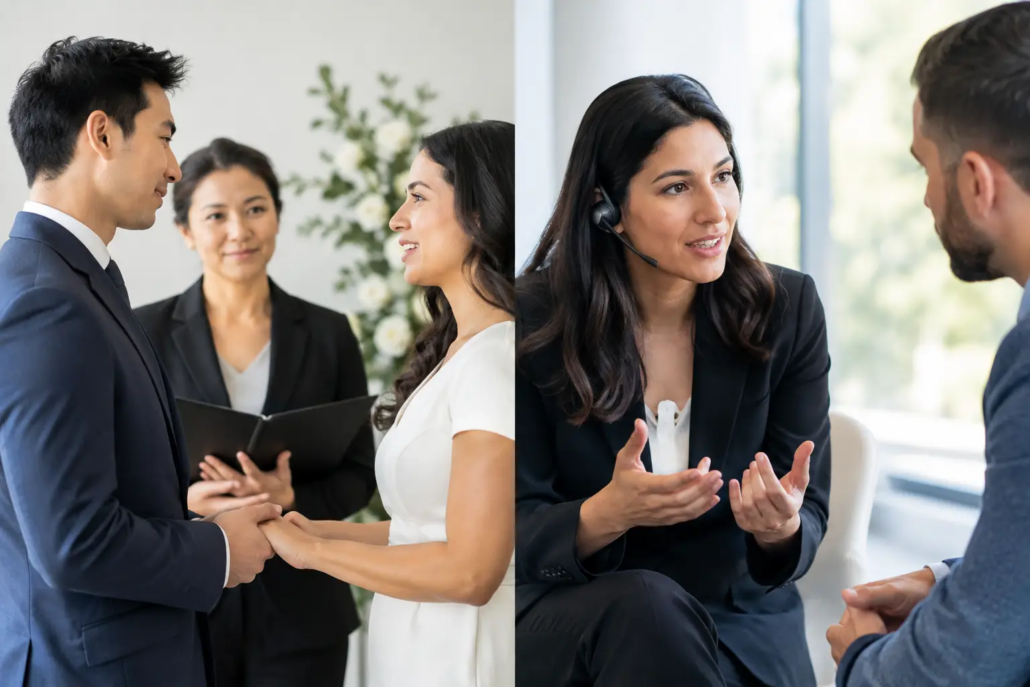
A bilingual ceremony is led in two languages by an officiant who speaks both. The officiant may alternate languages throughout the ceremony, repeat essential portions in each language, or thoughtfully divide sections between languages. For example, your welcome and family acknowledgment might be offered in English and Spanish, while a reading is shared first in Spanish and then in English.
An interpreter provides live interpretation of what the officiant, couple, and other speakers say. This may be consecutive interpretation, where a speaker pauses for the interpretation, or simultaneous interpretation, where the interpreter speaks or signs at the same time. An interpreter can be especially valuable when a couple needs language access that their officiant does not provide, or when a guest needs American Sign Language interpretation.
Both options can be caring and inclusive. They simply create different pacing, energy, and levels of flexibility.
When a Bilingual Ceremony Feels Most Natural
A bilingual ceremony often works beautifully when both languages are central to the couple’s relationship or family life. It can feel less like a translation service and more like one ceremony with room for everyone in it.
This approach is especially lovely for couples who want their cultural backgrounds woven into the script from the start. A bilingual officiant can help shape wording that sounds natural in both languages, rather than translating a generic English ceremony word for word. That matters with humor, family stories, spiritual references, and vows. The goal is not for every sentence to be identical. The goal is for every guest to understand the heart of what is happening.
A bilingual ceremony also gives you more control over what is repeated. You may want the welcome, your love story, ring exchange, vows, and pronouncement in both languages, while keeping a short legal statement in English only. Or you may prefer one language to lead certain moments and the other to lead others. There is room to create a rhythm that feels like you.
For many Seattle and Western Washington couples, this option is a comfortable fit for intimate weddings and family-centered celebrations. Grandparents can hear a welcome in their first language. Friends can understand the same sentiment in English. No one has to sit quietly and wait for the part they can follow.
The trade-off: timing and repetition
A bilingual ceremony generally takes longer than a ceremony in one language. If every line is spoken twice, a 15-minute ceremony can quickly become 25 or 30 minutes. That is not a problem if you want a fuller, more intentional experience. It may be less appealing if you are planning a brief ceremony at a park, a short legal signing, or an elopement with a tight timeline.
Thoughtful editing solves much of this. You do not need to translate every administrative sentence to make guests feel included. A skilled bilingual officiant can help you choose the moments that carry the most emotional weight and keep the ceremony warm, clear, and moving.
When an Interpreter Is the Better Choice
An interpreter is often the right answer when your guests need complete language access in a language your officiant does not speak. It is also the appropriate choice when accessibility needs are involved, particularly for Deaf or hard-of-hearing guests who use ASL.
If a parent, grandparent, or important group of guests would otherwise miss most of the ceremony, professional interpretation gives them a real place in the moment. That is more meaningful than handing out a printed translation and hoping they can keep up.
Interpreters are also helpful when several people will speak during the ceremony. Perhaps a relative will offer a reading in Mandarin, a friend will give a toast-like blessing in English, and your officiant will lead the rest of the ceremony in English. A qualified interpreter can help those voices be understood without asking family members to take on a job they may not be trained to do.
The trade-off: a different ceremony rhythm
Live interpretation requires planning around pauses, positioning, microphones, and sightlines. Consecutive interpretation can make a ceremony longer because each segment is spoken twice. Simultaneous interpretation can feel smoother for guests but may require additional equipment or careful audio coordination, especially at a larger venue.
It is also worth considering the emotional flow. Some couples love hearing a phrase in English followed by the interpreted language because it gives everyone a moment to absorb it. Others prefer a more continuous ceremony and may feel that a bilingual officiant’s integrated delivery better matches their vision.
Neither is more loving or more “authentic.” The best fit is the one that gives your people access without making the ceremony feel overly formal or complicated.
Do Not Ask a Relative to Interpret the Entire Wedding
A bilingual aunt, cousin, or friend may be delighted to read a blessing or help explain a family tradition. That is very different from asking them to interpret an entire ceremony in real time.
Interpreting takes concentration. The person interpreting cannot fully relax, cry at your vows, laugh at a story, or simply be your guest. They also need to accurately convey tone, meaning, and personal details in front of a crowd. That is a lot to ask of someone on an already emotional day.
If a loved one genuinely wants to participate, give them a meaningful role that lets them stay in the celebration. They could share a reading in their first language, offer a cultural blessing, present the rings, or help you choose wording that honors your family. Then let an experienced officiant or qualified interpreter carry the language-access responsibility.
Questions That Help You Decide
Start by thinking about your guests rather than the label. Who needs support to understand the ceremony? Is it one beloved grandparent, half of your guest list, or a broad mix of friends and relatives? The answer changes the best approach.
Next, consider whether you want both languages to be part of the ceremony’s voice or whether you need accurate access to one primary-language ceremony. If you want Spanish and English to live naturally throughout the script, a bilingual ceremony may feel especially personal. If you need a language outside your officiant’s fluency, an interpreter may be the practical and respectful choice.
Ask how long you want the ceremony to be, too. Couples planning a 10-minute elopement may choose a concise bilingual welcome and vows, while couples planning a 30-minute gathering may have space for readings, stories, and traditions in both languages.
Finally, think about what needs to be translated. Your guests may not need every logistical instruction repeated, but they should be able to understand the welcome, the promises, the exchange of rings, and the pronouncement. Those are the moments that tell them what they came to witness.
Build the Plan Before the Wedding Week
Once you choose your approach, share the full ceremony script with everyone involved early. A bilingual officiant can prepare language that is accurate and natural. An interpreter can review names, readings, cultural terms, and any words that may not have a direct equivalent.
For an interpreted ceremony, arrange a short conversation between the officiant and interpreter before the wedding day. Confirm where the interpreter will stand, whether they need a microphone, how speakers will pause, and how vows will be handled. If the ceremony is outdoors, make sure guests who need interpretation will have a clear view and can hear well.
For a bilingual ceremony, decide in advance which portions will be shared in both languages. This keeps the ceremony from feeling improvised and prevents an important family acknowledgment from being accidentally left out. It also helps your photographer and videographer anticipate a slightly different pace.
At Forever, Together, the ceremony is built around the people standing with you, not a one-size-fits-all script. Whether that means a Spanish-English ceremony, a carefully coordinated interpreter, or a few bilingual moments that honor a parent or grandparent, the details can be shaped with care.
Your wedding ceremony does not have to choose between being understandable and being heartfelt. Give your guests a way into the words, and they will be able to meet you fully in the moment that matters most.